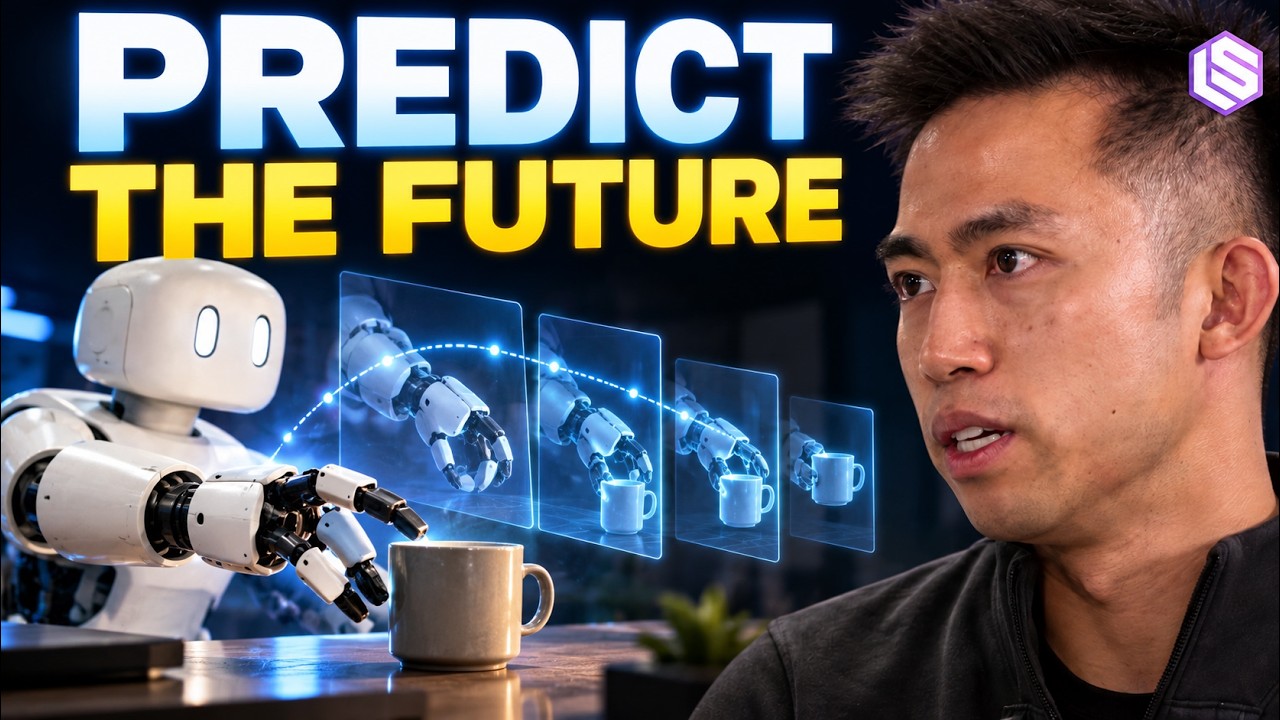
Robots That Predict the Future: Dyna-2 & Physical AI — Jason Ma, Dyna Robotics

About this episode
From the show’s notesFrom training a world-action model on over one million hours of human video to deploying robots that fold thousands of napkins daily at Din Tai Fung, Dyna Robotics is pushing physical AI beyond impressive demos and into real-world production. In this episode, Dyna Robotics co-founder and Chief Scientist Jason Ma joins swyx on-site to unpack how robots can learn new tasks from as little as 45 minutes of demonstrations, why predicting the future of the physical world may be the key to general-purpose robotics, and what it actually takes to build robots that work reliably for real customers.
We go deep on Dyna-2, Dyna's million-hour world-action model that combines future video prediction with robot actions, the scaling laws behind human-to-robot transfer, diffusion transformers and flow matching, and why synthetic environments and self-generated training data could unlock the next wave of robotics progress. Jason also explains why Dyna builds its own hardware instead of relying on off-the-shelf humanoids, how agentic harnesses enable robots to execute hour-long workflows, why dexterous hands and missing sensory data remain major bottlenecks, and what separates real commercial deployments from the graveyard of robotics startups. We also cover world-action models versus vision-language-action models, GPT-6 and coding agents in robotics, and Jason's journey from AlphaGo and Penn to NVIDIA, Google DeepMind, and founding Dyna.
Read the show’s notes in full
We discuss: - Why Dyna-2 was trained on over one million hours of human video - World-action models: predicting future video to guide physical robot actions - Diffusion transformers, flow matching, and real-time robotic control - How robots learn new tasks with as little as 45 minutes of demonstrations - Why robotics has no equivalent of the internet and data remains its biggest scaling challenge - Human egocentric video, robot demonstrations, and cross-embodiment transfer - Synthetic environments, simulation, and models that generate their own training data - Why robots need on-device inference, model distillation, and custom hardware - Why Dyna chose wheeled semi-humanoids instead of traditional bipedal robots - The hardware bottleneck: why dexterous robot hands still overheat - Best Western, Din Tai Fung, and the difference between robotics pilots and scaled deployments - The Bitter Lesson of Robotics: scaling data instead of engineering specialized solutions - Agentic harnesses and robots executing multi-step, hour-long physical workflows - GPT-6, coding agents, and AI-generated simulation environments for robotics research - World-action models versus VLAs, and why vision alone may not be enough - Jason's journey through AlphaGo, Penn, NVIDIA, Google DeepMind, and the Eureka project - Dyna's research culture, deployment-first philosophy, and vision for millions of robots