Simulating Humanity: from Generative Agents to 8 Billion Digital Twins — Joon Sung Park, Simile AI

About this episode
From the show’s notesNext episode → Language Agents: From Reasoning to Acting, with Shunyu Yao and Harrison Chase: youtu.be/8t65bss7U74
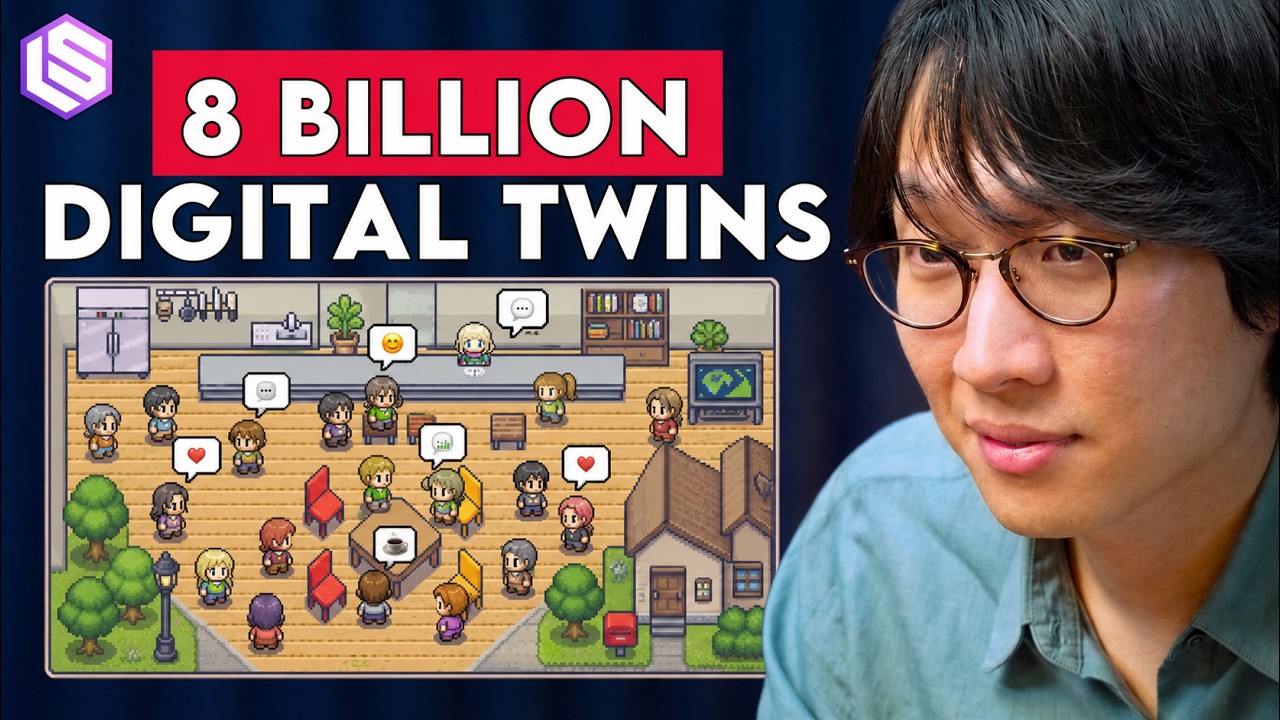
From creating Smallville, the landmark Generative Agents experiment that showed AI characters could remember, plan, socialize, and develop emergent behaviors, to now building foundation models of human behavior, Joon Sung Park is trying to answer a much bigger question: what if we could simulate the world before making decisions in it? In this episode, the Simile co-founder and CEO joins us to unpack the path from generative agents to digital twins, why today’s frontier models still fail to capture how humans actually behave, and what it would take to eventually simulate all 8 billion people on Earth.
Read the show’s notes in full
We go deep on Simile’s approach to modeling human behavior: long-form interviews, observational and transaction data, randomized controlled trials, population-level and individual-level models, and post-training on the causal mechanisms behind why people make decisions. Joon explains how his research created digital twins that reproduced human behavior and attitudes 85% as accurately as people reproduced their own responses, why models optimized to be rational can be bad simulations of irrational humans, and why understanding “social physics” may require changing model weights rather than simply prompting frontier LLMs.
We also explore the much larger ambition behind simulation: testing products and policies before deploying them, finding counterintuitive paths toward desired outcomes, modeling emergent behavior across entire societies, and potentially tackling problems like climate change, democratic instability, and UBI. Joon reflects on scaling laws for simulation, the economics of data-center-scale simulated worlds, the connection to Thomas Schelling and psychohistory, why simulation is surprisingly similar to painting, and whether we might already be living in one.
We discuss: • How Smallville and the Generative Agents paper led to Simile • Why Joon’s team asked: “What if we can just recreate the world that we live in?” • Why useful personal agents require deep models of the people they serve • Memory architectures, Markdown files, and the limits of prompting • “Social physics” and behavioral foundation models • Why web data captures what people say more than what they actually do • Interviews, transactions, observational data, and randomized controlled trials • Why predicting the future matters less than understanding how to shape it • How Simile creates representative simulated populations • Simulation versus prediction and the connection to Foundation’s psychohistory • How to evaluate simulations instead of simply stacking LLM hallucinations • Creating digital twins of 1,000 real people and reaching 85% behavioral accuracy • Why frontier models can struggle to reproduce real human behavior • Why good simulations need to reproduce human biases and mistakes • Post-training models on randomized controlled trials • Population-level versus individual-level simulation • Scaling laws for human simulation • The long-term ambition to simulate all 8 billion people on Earth • Whether simulations could help solve climate change or detect collapsing democracy • Thomas Schelling and the history of agent-based modeling • Why future simulations could require an entire data center • Multi-agent simulations and what happens when simulated people interact • Replacing expensive human panels with synthetic populations • Why market research is only the starting point for simulation • Why Joon sees simulation as surprisingly similar to painting • Using simulation to study questions like UBI • Whether we are already living in a simulation • Why AGI and simulation may be the twin technologies of advanced civilizations