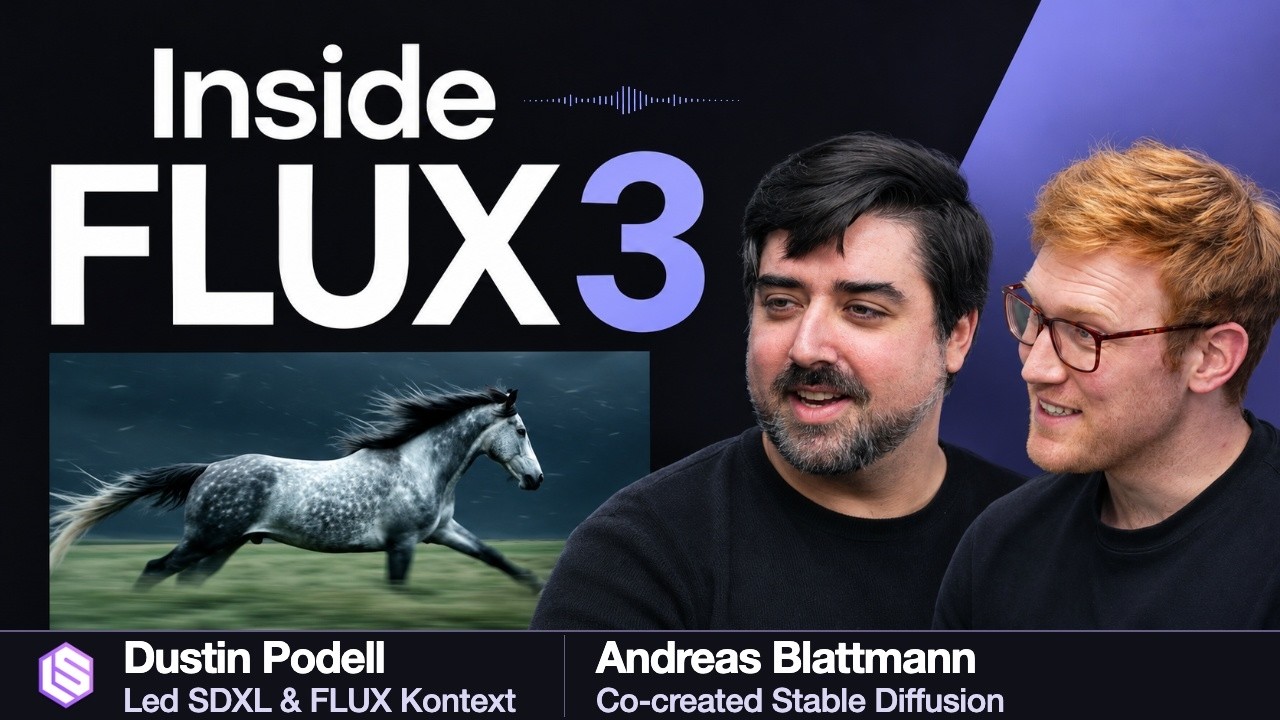
Building Visual Intelligence — Andreas Blattmann & Dustin Podell, Black Forest Labs

About this episode
From the show’s notesA camera moves around a person. Halfway around, the model has to draw the back of a head it has never seen. How much can it learn about that missing view just by watching video? That’s the question we put to Andreas Blattmann and Dustin Podell of Black Forest Labs.
Their answer runs through FLUX 3. BFL trained one backbone on images, video and audio. The guests explain what each adds, how they decide which parts of denoising deserve the most compute, and why a detail that looks great in a still can flicker from frame to frame. We also get into the case for autoregression and where they think diffusion still has an edge.
Read the show’s notes in full
There’s personal history here. Stable Diffusion is why Dustin left his software job and why swyx started Latent Space. They revisit the first FLUX training run in a French chalet, the photo experiment behind FLUX Kontext, and some of the things people actually use these models for, from restoring old family photos to generating a clip with synchronized sound.
This episode is sponsored by Deepgram. Deepgram is the voice AI infrastructure behind natural conversation—bringing speech-to-text, text-to-speech, voice-focused LLMs, and agents to teams building with voice AI. deepgram.com
Chapters
Show notes
• BFL’s account of why it trained FLUX 3 across images, video and audio — bfl.ai/blog/flux-3
• Watch FLUX 3 generate video with synchronized sound —
bfl.ai/blog/flux-3-video
• Try the night-to-day image edit mentioned in the episode — bfl.ai/models/flux-kontext
• Andreas Blattmann co-created Stable Diffusion and co-invented latent diffusion —
• Dustin Podell led FLUX Kontext and was lead author of SDXL —
• The first Latent Space essay, written after the Stable Diffusion release —